
The County Championship Explained: Divisions, Points and the Long Game
 Available in US

The Oldest Tier in English Cricket
The first time I tried to explain the County Championship to a friend from the US, she stopped me about a minute in and said it sounded like Test cricket organised by postcode. That is not the worst summary I have heard. The Championship is four-day red-ball cricket played by eighteen counties across an English summer, and the people who care about it care more than they probably should.

The 2025 County Championship marked the 125th season of the competition, with eighteen teams playing 126 matches across the summer. Nottinghamshire won their seventh title. The competition sits as the deepest layer of red-ball cricket in this country — older than Test cricket itself, in fact, since the Championship pre-dates the formal Test era by more than a decade.

What makes the Championship worth understanding even if you do not follow it closely is how much of English cricket runs through it. The Test team’s selection is built almost entirely on Championship form. The Hundred and T20 Blast pull from the same player pool. The grassroots clubs feed into county systems. The whole pyramid sits on top of these eighteen counties, and the structure has shaped English cricket for nearly a century and a half.
How the Two Divisions Work
The eighteen counties are split into two divisions. Division One contains ten teams. Division Two contains eight. The structure has been adjusted over the years — the sizes of the divisions, the number of fixtures per team, the promotion and relegation rules — but the two-division shape has been stable for over two decades.
Within each division, teams play each other home and away across the summer, with some seasons including additional non-divisional fixtures. The 2025 schedule produced 126 matches in total, which sounds enormous until you remember it is spread across eighteen teams over six months. Most counties play around 14 four-day matches in a season, with the gaps filled by white-ball cricket from May through August.
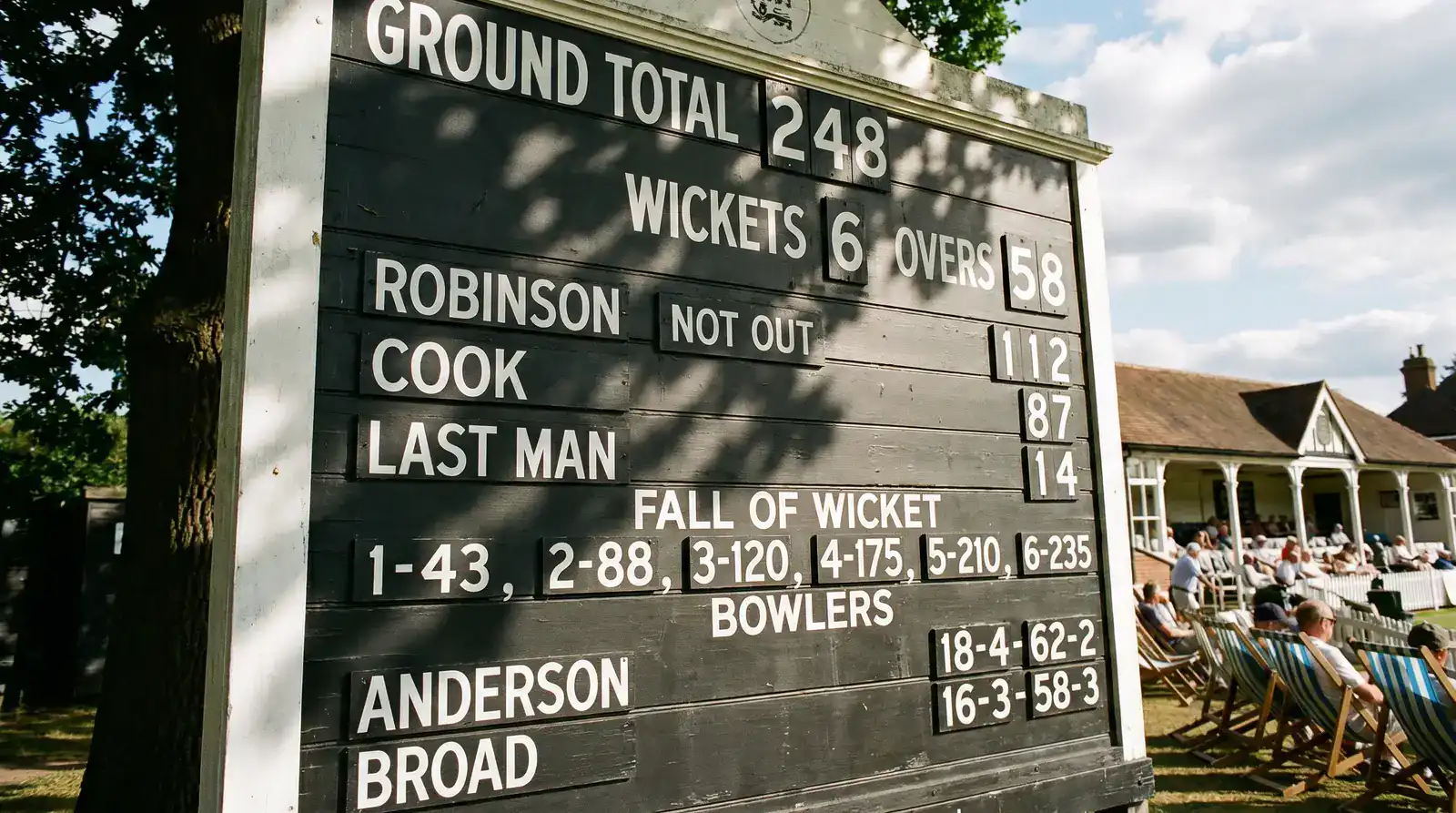
Division One is the headline competition. It contains the wealthier, more historically successful counties — though “wealthier” is relative in domestic cricket and the financial gap between Division One and Division Two is smaller than the league-position gap would suggest. The teams in Division One play for the Championship title; the teams in Division Two play for promotion and a chance at the title the following year.
What this means for live-score traffic during the Championship summer is that Division One produces more attention. The Tests in that division shape England selection conversations and produce the highest-profile head-to-head fixtures of the year. Division Two matches are followed closely by the supporters of the eight counties involved and by national selectors looking for emerging players, but the broader audience tends to focus on the top tier.
The Points System: Wins, Draws, Bonus
The Championship’s points system is one of the most distinctive aspects of the competition and the part most casual viewers misunderstand. Points are awarded not just for results but for performance during a match — the system rewards positive cricket even when the result does not go a team’s way.
A win produces 16 points. A draw produces 8 points each. A tie — extremely rare in four-day cricket — produces 8 points each. A loss produces 3 points for the losing side if they have completed certain milestones during the match. The base points alone do not capture how much movement happens on the table.

Bonus points are the layer that makes the system interesting. Teams earn bowling bonus points for taking wickets within the first 110 overs of the opposition’s first innings — up to 3 points for taking 9 or 10 wickets in that window. Teams earn batting bonus points for runs scored in the first 110 overs of their own first innings — up to 5 points for scoring 400 or more in that window. The bonus points are added regardless of the eventual match result, which means a team can finish a drawn match with as many as 16 points if they hit all their batting and bowling targets.
The 2024 Championship saw a sharp rise in spin overs bowled — spin accounted for 1,035 overs in Division One that season, up from 767 the year before. That shift produced different bowling-bonus-point dynamics, with spinners taking more of the wickets and the early-overs window shaping match strategy more directly than in seasons dominated by seam bowling.
The deduction layer is the other part of the system worth knowing. Teams can lose points for slow over-rates, disciplinary breaches, and pitch deficiencies. A single deduction can wipe out a full match’s earnings, and counties take the rules seriously enough that few finish a season with significant deductions on the board.
Promotion, Relegation and the Pressure Points
Two teams are relegated from Division One at the end of each season. Two are promoted from Division Two. The structure produces a clear churn between the divisions and a stable competitive intensity across both, with the lower half of Division One always conscious of the trap door and the top of Division Two always hopeful of climbing.
The relegation battle is often the most-watched part of the season’s final weeks. Counties on the edge of the bottom-two zone play their final fixtures with a kind of pressure that the top-of-table teams rarely face — a relegation costs the club significant prize money, broadcast attention, and recruiting status for the following year. Promotion conversations work in mirror, with the top of Division Two pulling almost as much attention as the title race itself for the supporters of the counties involved.

What I find consistently interesting about the Championship is how the same player can be playing for two different stakes depending on the league position. A senior batter on a mid-table Division One team in August might be playing for individual reputation rather than collective outcome — the team is safe from relegation and not in the title race. The same player a year later, after a relegation, might be playing for promotion in Division Two where every match matters.
Rob Andrew, the ECB Managing Director, has been clear in recent years about the value of the county game extending beyond the Championship itself — the format debates around overseas players, the Blast, and the Championship all connect to a wider conversation about how the county system supports the broader growth of the sport. That broader value is what keeps the four-day format viable financially even when the live audiences at most county grounds remain small compared to The Hundred or international cricket.
Tracking County Championship Scores Live
The Championship has the most distinctive live-score requirements of any UK cricket competition because the matches run across four days and the action can stretch across the entire daylight window in the English summer.
The ECB Match Centre carries ball-by-ball coverage of every Championship match, with full scorecards updated in real time. The platform also carries live video of selected matches — a feature that has expanded considerably since the launch of the Supporters’ membership. The video coverage is not comprehensive across all 126 matches, but the major fixtures in both divisions are usually available.

Cricket apps with strong UK coverage carry Championship scores, though the depth of coverage varies. The major aggregators tend to prioritise international and franchise cricket, which means Championship scorecards on some platforms are functional rather than rich. The dedicated red-ball cricket follower tends to default to the ECB platform for live county coverage rather than rely on the global apps.
The BBC carries text commentary on its sport pages for selected Championship matches, with most of the home-county BBC stations carrying audio commentary on their counties’ fixtures. The audio coverage is one of the genuinely lovely things about following the Championship — local commentators who know the county inside out, calling matches in front of small but engaged audiences, with the kind of detail that the major broadcasters rarely match.
Live-score traffic on Championship matches tends to be steady rather than spiky. The four-day format means the audience checks in across the day rather than glueing themselves to a single session. Lunch and tea intervals produce moderate spikes. Wicket falls during the morning and afternoon produce smaller ones. The compound effect across the full day is significant, even though no single moment produces the kind of traffic peak that a T20 final or an Ashes Test does.
If you want the wider context on where the Championship sits inside the UK domestic calendar — alongside the One-Day Cup, T20 Blast, and the Hundred — there is more on that in our UK cricket season calendar guide.
Prepared by the Stumply editorial staff.
