
Cricket Officiating Technology: DRS, DLS, Hawk-Eye and the Numbers Behind Them
 Available in US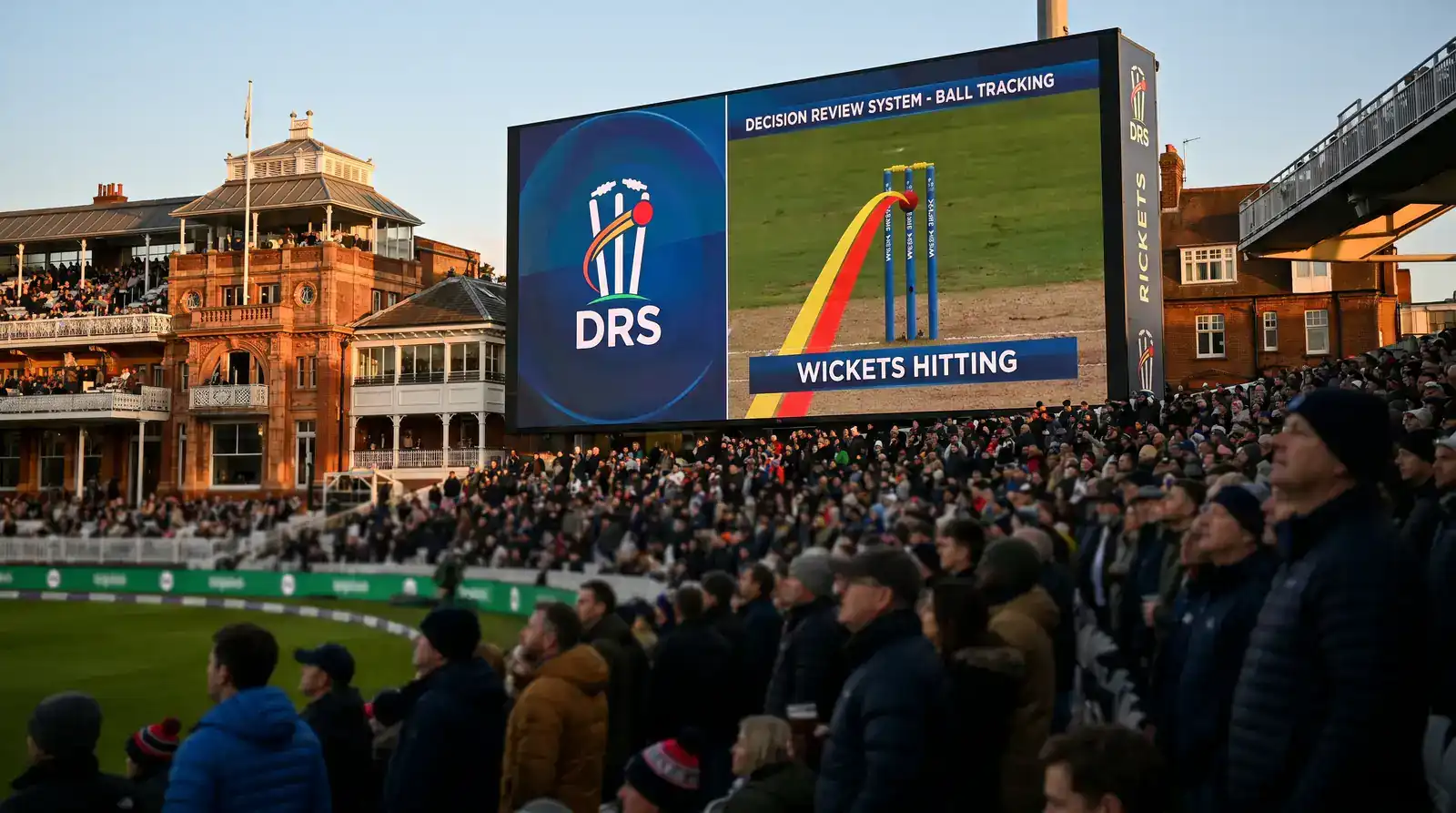
Why Numbers, Not Just Replays, Drive Modern Officiating
The first time I watched a DRS review unfold at a Test ground, I was at Lord’s in 2018, and what struck me wasn’t the replay — it was the silence. Twenty-seven thousand people watching a giant screen wait for a percentage probability to be calculated. The umpire’s finger was already up; the bowler had already started celebrating; the batter had reviewed; and now the entire ground was watching a graphic of a red ball clip the top of an off-stump bail in slow motion. The crowd noise resumed only when the verdict appeared.
Cricket officiating has been transformed by technology in a way that no other sport has quite matched. Football has VAR but uses it sparingly. Tennis has Hawk-Eye line-calling but the umpire’s authority is mostly intact. Cricket has built an entire ecosystem of tools — DRS for player reviews, the DLS Method for rain-affected targets, Hawk-Eye for ball tracking, UltraEdge for sound detection, front-foot cameras for no-balls — and laid them on top of the umpires’ own judgement.
The numbers behind that ecosystem are striking. The introduction of DRS lifted the accuracy of umpiring decisions from approximately 93% to over 98%. DRS itself is involved in roughly 15% of all wickets in Test cricket. Hawk-Eye’s ball-tracking system claims an accuracy of around ±5 millimetres at the point of first contact. These aren’t marketing numbers — they’re the operating tolerances at which the sport is now being officiated, and they show up in the form of overturned decisions, recalculated targets, and tiny green-or-red blips on the broadcast screen.
This guide unpacks each technology in turn: how it works mechanically, what the accuracy actually means, where it sits on a live scorecard, and where the tech still falls short. I’m going to be specific about numbers because the technology only makes sense when you understand its margins of error.
How the Decision Review System Works in Practice
DRS — Decision Review System — gives a team the right to challenge an on-field umpire’s decision. The mechanics are strict and theatrical: a player must signal a T-shape with their hands within 15 seconds of the umpire’s decision. If they take longer, the review is forfeited. If they signal in time, the third umpire takes over.
What follows is a sequenced check. The third umpire looks first at whether the bowler delivered a legal ball — front foot behind the popping crease, no overstepping. If a no-ball is detected, the original decision is automatically overturned in the batter’s favour. Then the audio and edge-detection technologies are reviewed: did the ball brush the bat or the gloved hand? UltraEdge produces an audio waveform synchronised to the video frames, and the third umpire is looking for a spike at the exact frame of impact. If an edge is detected on an LBW review, the original decision is overturned in the batter’s favour.
Only if neither no-ball nor edge resolves the question does Hawk-Eye get used. The ball-tracking software reconstructs the delivery’s trajectory, projects it forward from the point of impact with the batter, and shows where the ball would have struck the stumps. The verdict depends on three checks: pitching (where did the ball pitch?), impact (where did it strike the batter?), and wickets (would it have hit the stumps?). Each check has a binary result — yes, no, or “umpire’s call”, which I’ll come back to in detail in the next section.
Each team has a fixed number of reviews available. In Test cricket the standard allocation is three unsuccessful reviews per innings — a successful review (one that overturns the decision) doesn’t cost the team. An “umpire’s call” verdict on an LBW also returns the review to the team, on the principle that the technology couldn’t definitively rule either way. T20 internationals usually allow two unsuccessful reviews per innings; The Hundred uses the same.
The data on how often DRS gets used is telling. Around 15% of all wickets in Test cricket involve DRS — either as a successful overturn of a not-out call, or as a confirmation of an out call that the batter unsuccessfully challenged. The most common scenario is an LBW appeal where the on-field decision was unclear and a review either confirms or overturns it.
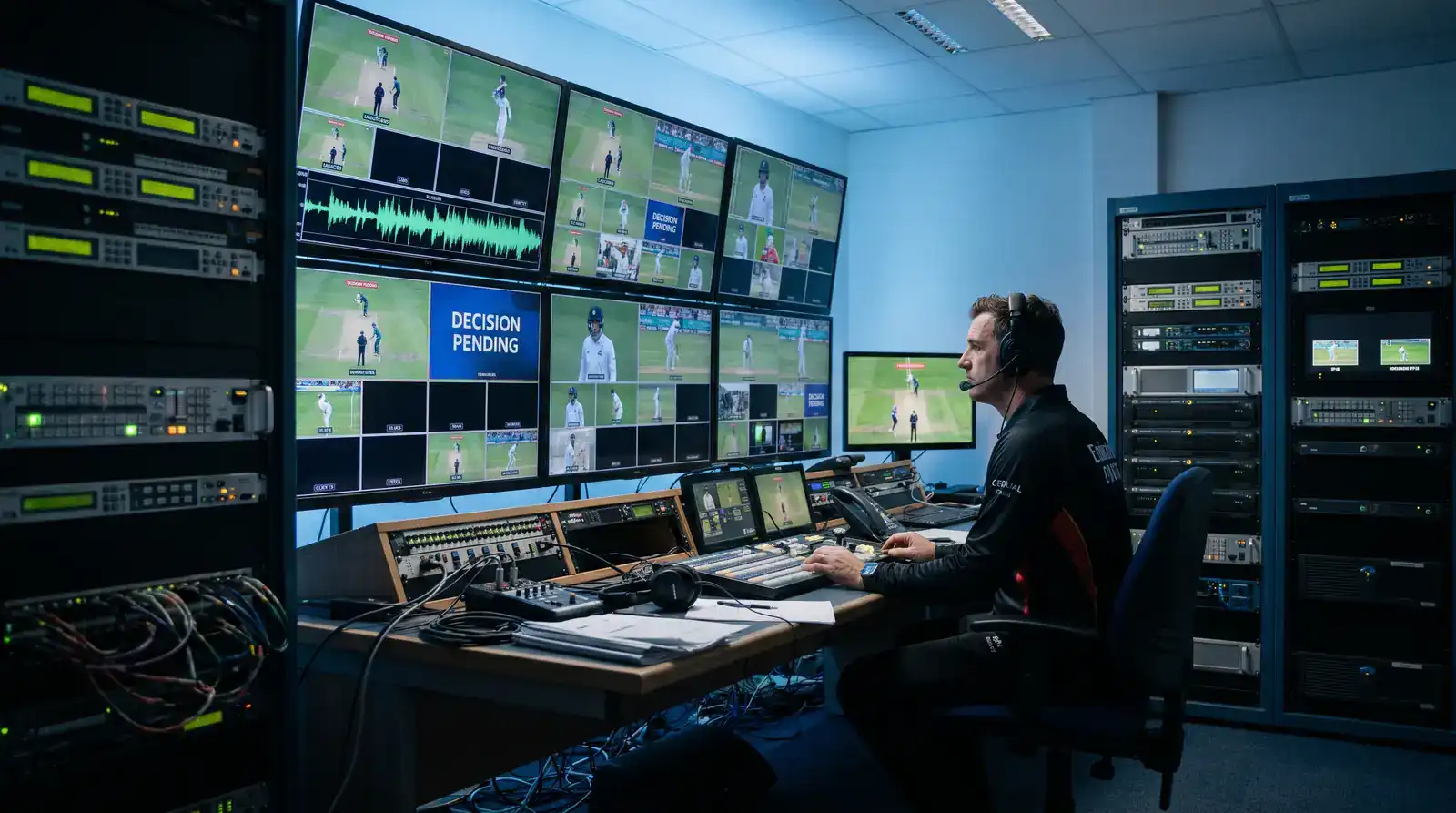
One detail that surprises new viewers. The third umpire doesn’t simply watch replays — they have an entire control room with synchronised feeds from every Hawk-Eye camera, every stump-mic angle, and every broadcast camera at the ground. The review is a structured technical investigation, not a quick second look. A typical review takes 60 to 90 seconds to resolve, during which time the bowler retreats to their mark and the captain has a quiet word with the slips.
Umpire’s Call: The Grey Zone That Splits Fans
Umpire’s call is the rule that gets shouted at television sets in pubs across England every Test summer. The principle, once you understand it, is conservative and defensible. The execution, when it costs your team a match, is genuinely infuriating.
The rule applies to LBW reviews. After Hawk-Eye projects the ball’s path onto the stumps, the verdict on whether the ball would have hit the wicket is divided into three categories. “Wicket hitting” — the projected ball strikes the middle of the stumps or close to it — counts as out. “Missing” — the projected ball passes outside the stumps entirely — counts as not-out. “Umpire’s call” — the projected ball clips a tiny portion of the stumps’ edges — leaves the on-field umpire’s original decision intact. If the umpire raised the finger, it stays out. If the umpire didn’t, it stays not-out.
The reasoning is that Hawk-Eye’s predictive path has a small margin of error — typically ±2 millimetres at the wicket zone — and if the ball is only marginally clipping a stump, the technology can’t be confident enough to overrule a human umpire who was watching from 22 yards away.
The wicket zone itself was redefined in 2021. Prior to that change, the zone covered the area between the bottoms of the bails and the inner edges of the stumps. From 2021 onwards, the zone was expanded to include the entirety of the bails — meaning a ball clipping the top of a bail now counts as a definitive hit rather than as umpire’s call. The change had a measurable effect: the overturn rate for non-umpire’s-call LBW reviews rose from 22% to 27% in the years following the rule change. More decisions are now resolved definitively, and fewer are kicked back to the umpire’s original call.
What umpire’s call does to a team’s review count is the second source of confusion. If a review returns “umpire’s call”, the team does not lose the review. The logic: the technology was inconclusive, so the team isn’t penalised for a reasonable challenge. This rule was added in part to encourage teams to use DRS without the risk of losing reviews on close decisions.
For a UK viewer following a Test on Sky, the umpire’s call moment is always the most theatrical. The graphic on screen shows a yellow segment of the stumps where the ball is projected to clip. The crowd noise dips. The third umpire’s voice comes through the stump mics. And the verdict — “the on-field decision was not-out, the decision remains not-out” — is delivered with the deliberate calm of a courtroom judgement.
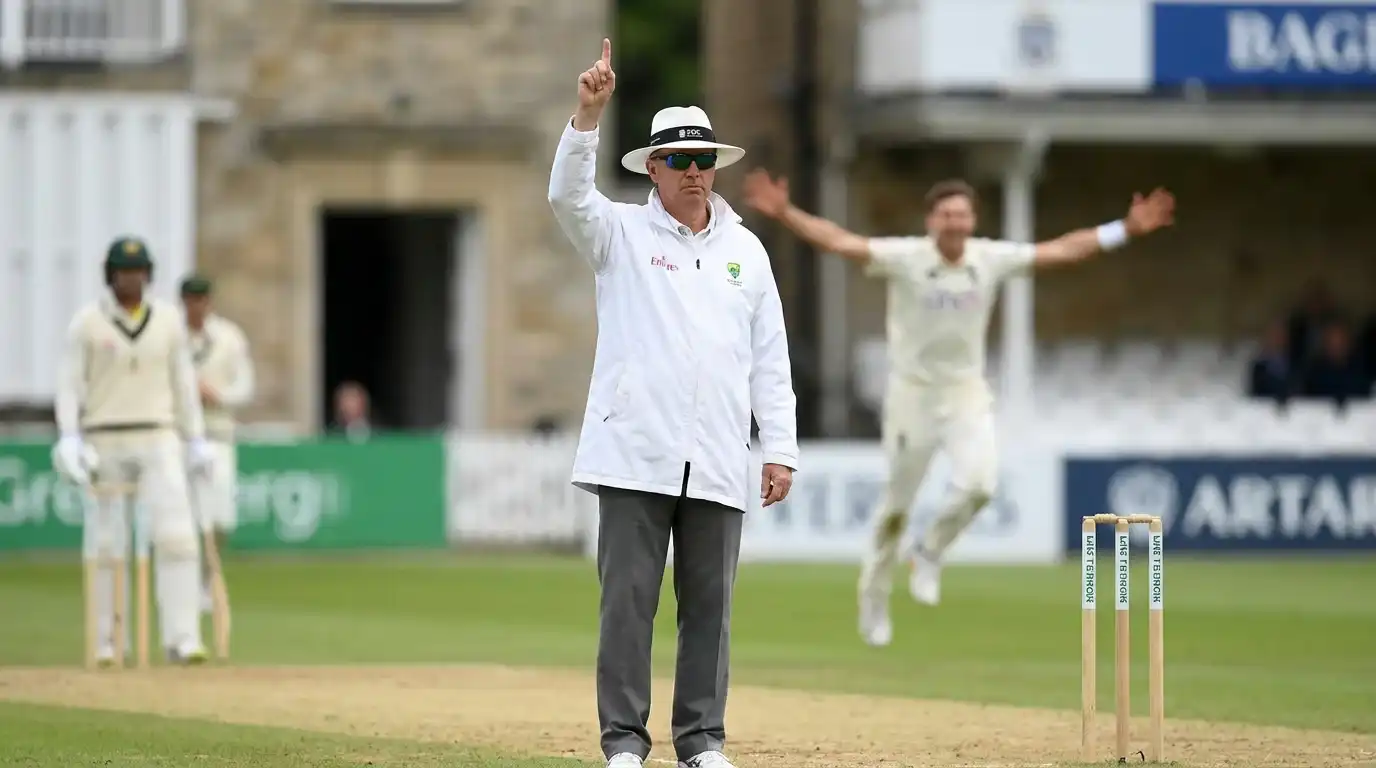
The arguments against umpire’s call cluster around the same point: the same ball, projected to clip the same fraction of a stump, can produce two opposite verdicts depending on what the on-field umpire said in the first second after appeal. Defenders of the rule reply that this is the point — the on-field umpire’s authority is being preserved, and the technology is being used as a corrective rather than as an oracle. Both arguments are reasonable. The debate continues.
Hawk-Eye Accuracy and the Margin of Error
Hawk-Eye is now used in cricket, tennis, football, snooker and a handful of other sports. In cricket it’s used for ball tracking — reconstructing the path of every delivery from the bowler’s hand to the batter, and projecting where the ball would have travelled after impact.
The system uses ten high-speed cameras positioned around the ground. Each camera captures the ball at 340 frames per second. Software combines the multiple two-dimensional camera images into a single three-dimensional path. The result is a real-time geometric reconstruction of every delivery, with claimed accuracy of around ±5 millimetres at the point of first contact with the batter.
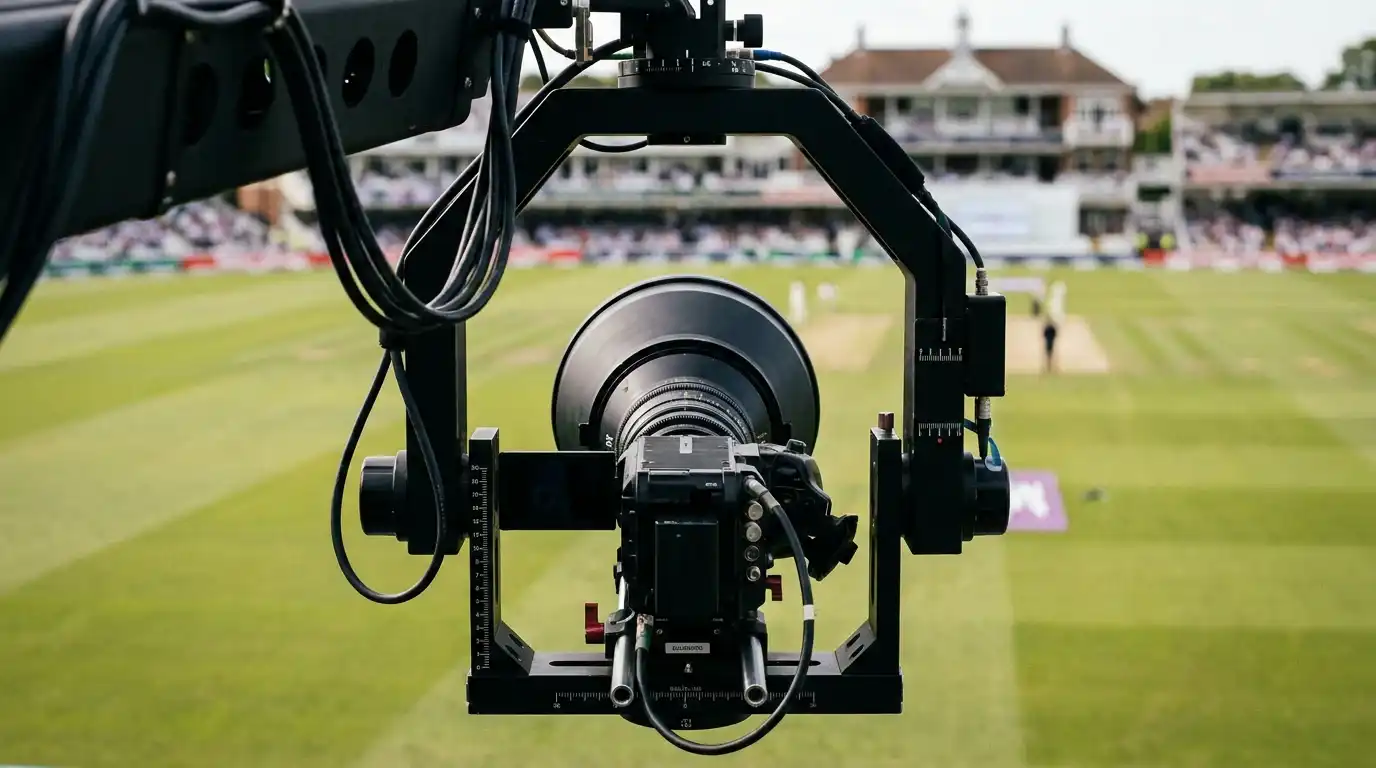
The accuracy figure depends on what’s being measured. The first-contact accuracy — where the ball strikes the batter, or where it would have struck the stumps if no batter were in the way — is the tightest tolerance. The predictive accuracy — where Hawk-Eye projects the ball would have gone after impact, based on extrapolating the pre-impact trajectory — carries an additional algorithmic uncertainty of roughly ±2 millimetres. The combined error margin at the wicket zone is therefore close to ±7 millimetres in worst-case scenarios.
Why does that matter? Because a stump is 38 millimetres wide. A 7-millimetre error margin is over 18% of the stump width, which is why “umpire’s call” exists — the technology can’t claim more than 80%+ confidence on a ball that clips the very edge of the stump.
“More and more batsmen try and get away with not walking,” Paul Hawkins, the system’s inventor, told the BBC in 2016. “But we experimented in the nets and found that even the smallest edge is detected.” That comment was about edge detection rather than LBW projection, but the same engineering philosophy runs through both: build tight enough tolerances and human judgement gets a forensic backup.
Hawk-Eye accuracy degrades in a few specific scenarios. If the ball is intercepted very close to the stumps — within roughly 2 metres of the wicket — the predictive segment of the trajectory is shorter, and there’s less data for the system to extrapolate from. Conversely, if the ball is intercepted very early — pitching short and striking the batter on the front pad before any meaningful turn or swing has developed — the projected path is also less reliable because the ball hasn’t yet “settled” into its line.
The system also handles spin and pace differently. For a fast bowler, the trajectory is closer to a straight line, so projection is mathematically simpler. For a spinner, the ball is decelerating and may have changed direction mid-flight, so the projected path requires more inputs and carries marginally wider tolerances. The “umpire’s call” graphic appears more often on spin deliveries than on pace deliveries, which reflects this difference.
For the UK viewer, the takeaway is that Hawk-Eye is precise but not omniscient. The technology gives you a yes/no/maybe verdict on every projected delivery, and the maybe — umpire’s call — is the explicit acknowledgement that some balls are too close to be settled by software alone.
UltraEdge, Snicko and Hot-Spot Compared
Three technologies sit between bat and caught-behind: Snickometer, UltraEdge, and Hot-Spot. The first two are sound-based; the third was infrared. Together they answer the question “did the ball touch the bat?”, and they don’t always agree.
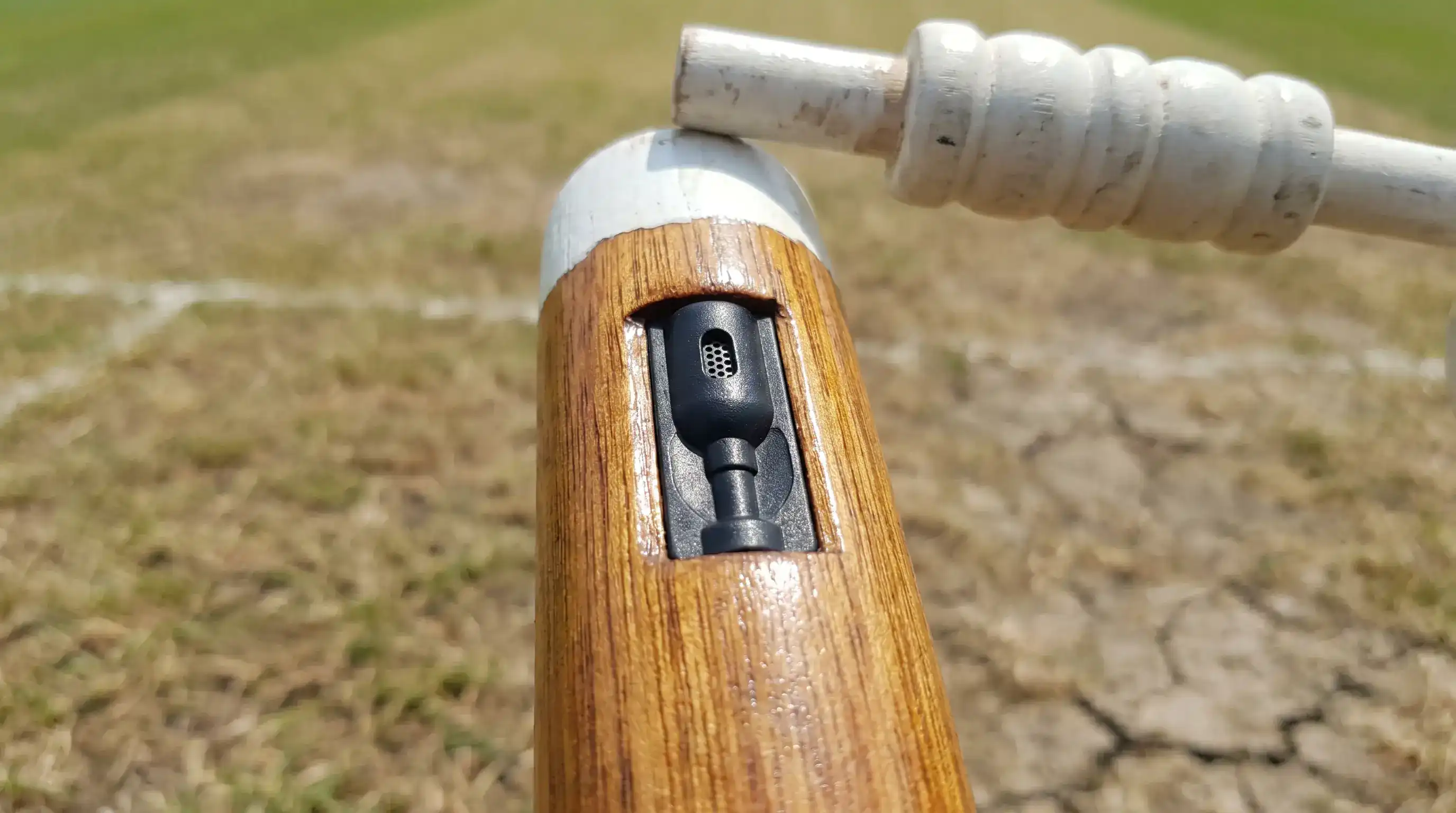
Snicko was the original. The system uses a stump microphone synchronised to video, displaying an audio waveform alongside frame-by-frame footage of the delivery. A spike in the waveform at the exact frame the ball passes the bat is interpreted as an edge. Snicko had a high false-positive problem — the stump microphone picks up bat-on-pitch contact, bat-on-pad contact, and ambient ground noise, all of which can produce spikes that look like edges. Reading a Snicko display required the third umpire to correlate the waveform peak with the precise frame of bat-ball alignment.
UltraEdge replaced Snicko in most major leagues from around 2016. The technology uses a more sensitive microphone array, with directional capability that can distinguish bat-on-ball contact from other sources of noise. The display shows the same waveform but with cleaner peaks and reduced background interference. UltraEdge is now the default for international and franchise cricket — including The Hundred, IPL, and County Championship matches with full broadcast coverage.
Hot-Spot was the third tool, an infrared system that detected the heat signature of bat-on-ball impact. Where there was contact, a small bright spot appeared on the bat. The technology was used heavily through the 2010s but has largely been phased out — partly because it was less reliable on lower-quality bat finishes, and partly because the equipment was expensive enough that broadcasters preferred to consolidate around UltraEdge for the same task.
The three tools occasionally disagree. The classic disagreement scenario is a “no spike, no Hot-Spot, but visible deviation” — the video shows the ball changing trajectory at the bat, but the audio and infrared don’t confirm contact. In that situation the third umpire is guided to side with the on-field decision. Conversely, “spike but no deviation” — an audio peak with no visible ball-change — is usually interpreted as bat-on-pad rather than bat-on-ball, particularly if the timing of the spike doesn’t align precisely with the ball passing the bat.
UltraEdge also has limits. The system can pick up brushed-pad contact and confuse it with bat-edge contact, particularly when the bat is held very close to the front pad. The third umpire’s training emphasises checking the audio spike against the visual moment of ball-pad-bat alignment, and not relying on the waveform alone.
For viewers, the order of tools in any review is usually audio first (UltraEdge for the spike), video second (frame-by-frame for the deviation), and Hot-Spot — where still used — as a tiebreaker. Watching these tools at work is a kind of forensic theatre that cricket has uniquely embraced.
The DLS Method: Targets That Move with the Weather
The DLS Method — Duckworth-Lewis-Stern — is the system by which cricket recalculates a target when rain interrupts a limited-overs match. It is the most misunderstood piece of cricket mathematics in mainstream coverage and the most consequential to actual match results.
The method’s basic principle is that a team’s scoring capacity depends on two resources: overs (or balls) remaining, and wickets in hand. Lose either resource and the scoring potential shrinks. A team with 30 overs and ten wickets has more scoring resource than a team with 30 overs and two wickets. DLS assigns a numerical value to each combination of overs-remaining and wickets-in-hand, and uses that table to compute a fair revised target when overs are lost to rain.
The system was developed by Frank Duckworth and Tony Lewis in the 1990s, replacing an earlier “average run rate” method that produced wildly unfair results. The “S” — Stern — was added by Steven Stern of QUT in 2014 to update the method for the higher scoring rates of modern T20 cricket, particularly in the death overs.
The mechanics on a live broadcast: when rain interrupts an innings, DLS calculates how much “resource” was lost. The new target is computed as the original target adjusted for the resource ratio. If a team batting second had 70% of their resources remaining when rain stopped play, and play resumes with only 50% of resources available, the revised target is recalculated to reflect what would have been a fair chase given the reduced overs and wickets in hand.
The “DLS par” score is the most visible artefact of the method during a chase. It shows, in real time, what the batting side’s total should be at a given over-and-wickets combination to be on course for victory. If the chasing team is at 87/3 after 15 overs and the DLS par at that point is 92, the team is five runs behind par — they need to score those five runs back or risk a defeat if rain ends play. The par score recalculates every ball and dynamically updates the scoreboard graphics on Sky and most cricket apps.
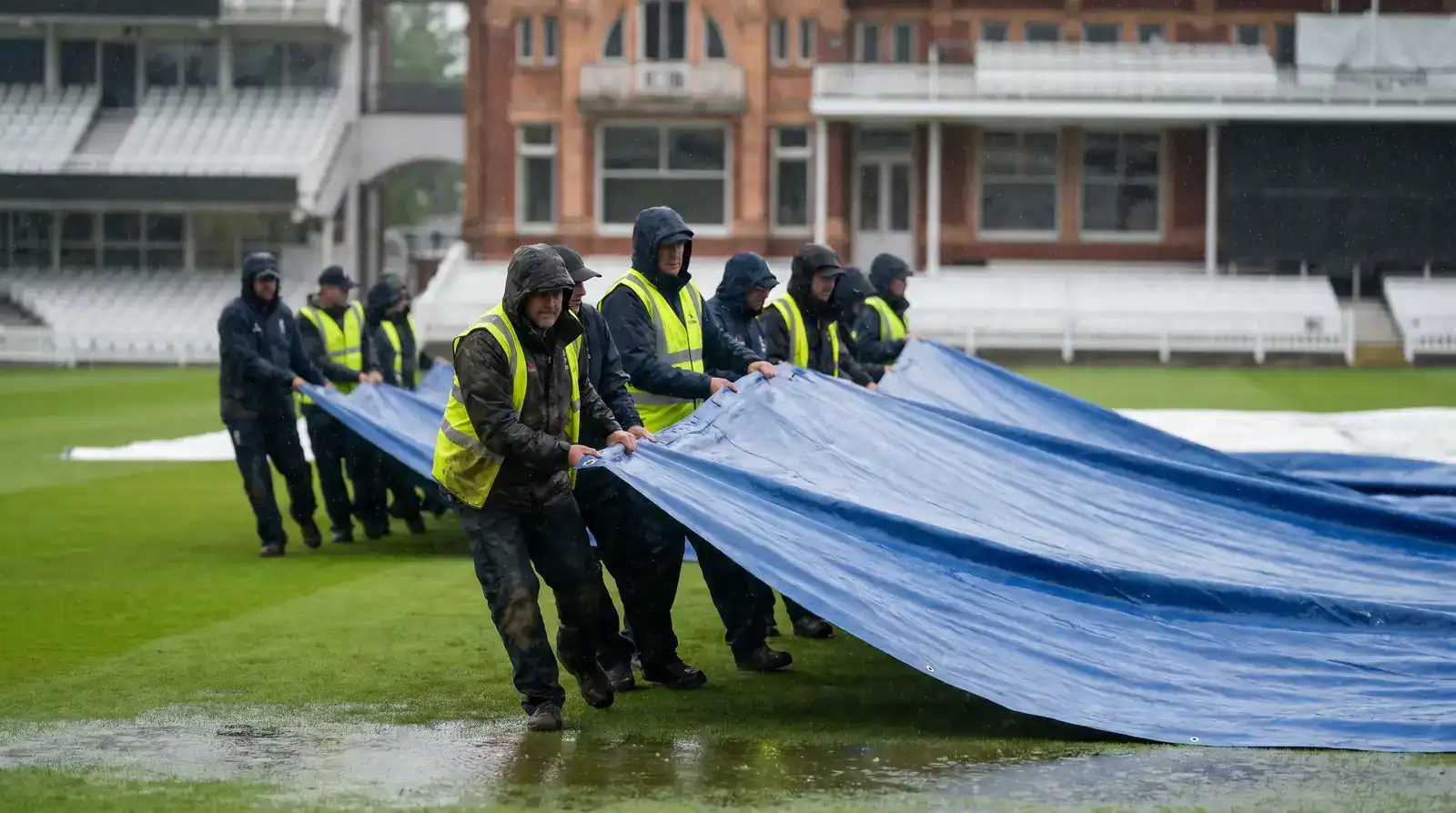
DLS is used in ODI and T20 internationally. The Hundred uses a modified version adapted for the 100-ball innings structure. Test cricket has no DLS — there’s no fixed over limit to recalculate against, so rain just costs the available wickets time. In the County Championship the same applies; rain shortens days but doesn’t trigger a target revision.
Where DLS falls short: it doesn’t handle situations where the chase is mathematically impossible after the rain break, or where the rain break is so brief that the resource adjustment is negligible. The method also doesn’t account for pitch deterioration — a team batting in a rain-affected session may face a more difficult surface, which DLS treats as identical to the pre-rain conditions.
The mechanics are intricate enough that a deeper walkthrough of the resource tables and worked examples sits beyond the scope of this guide. For practical viewing, what matters is the par score on the scoreboard and the rate at which it recalculates.
Front-Foot No-Ball Cameras and Real-Time Calling
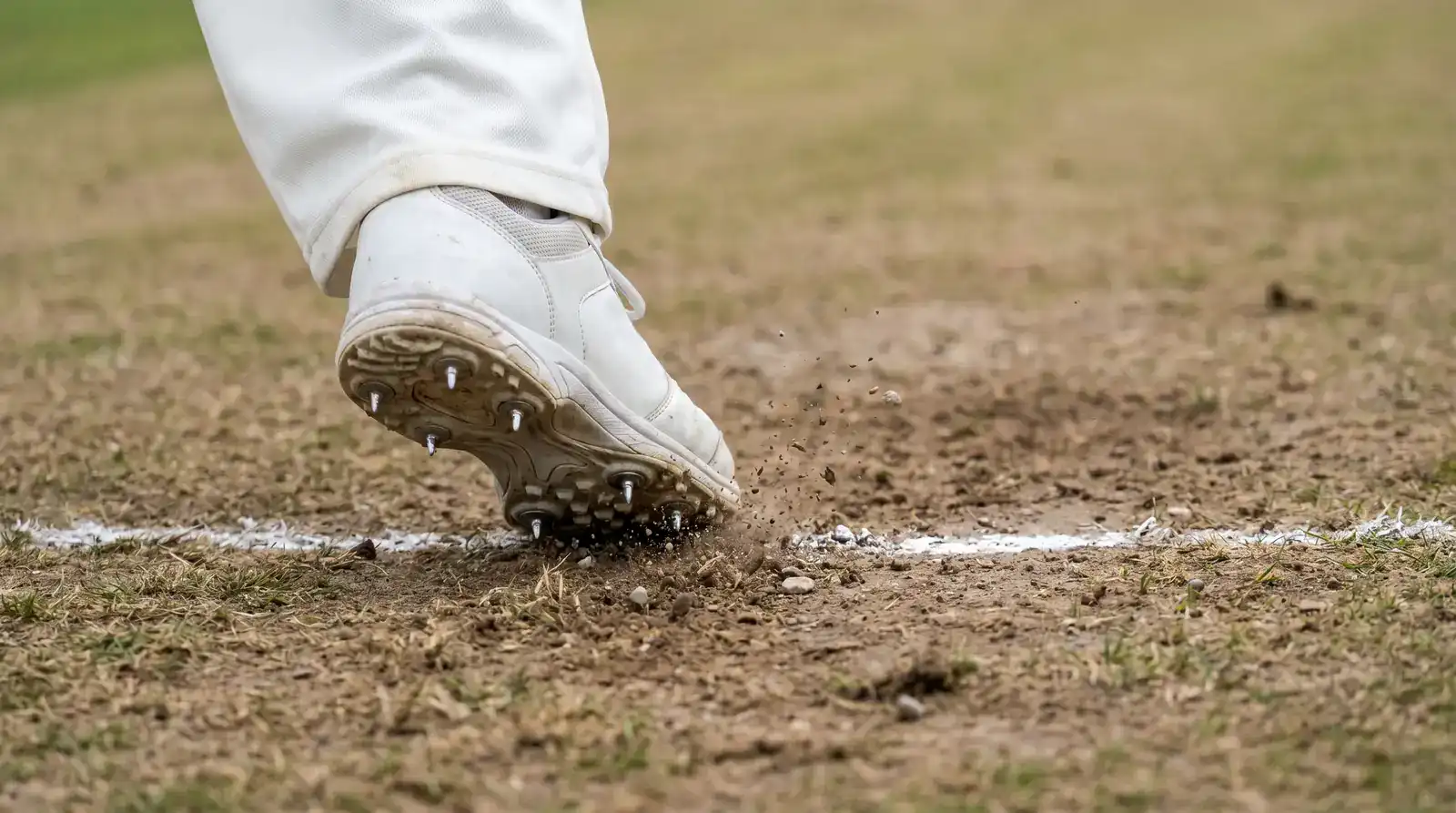
Front-foot no-balls are the small officiating moment that used to slip through the cracks. A bowler whose front foot landed across the popping crease was, technically, delivering a no-ball — but the on-field umpire had to spot it while simultaneously watching the delivery itself. Studies showed up to 20% of front-foot no-balls were going uncalled in some matches.
The solution, rolled out across international cricket from 2020 and now standard in The Hundred, the IPL and most franchise leagues, is a dedicated camera positioned at the popping crease at each end. A third umpire — separately from the one handling reviews — monitors only the front foot, ball by ball. Within a few seconds of each delivery, that umpire signals to the on-field umpire whether the bowler landed legally.
The mechanics are quietly clever. The front-foot camera operates at high frame rate and zooms in on the bowling line. The third umpire has a binary decision to make: was the front foot behind the line, or across it? If across, the on-field umpire is informed and the no-ball is called. The batter still has the same advantages as a normal no-ball — extra run added, free hit in white-ball cricket, and the wicket can’t fall to a bowled or LBW dismissal off that delivery.
In the County Championship, front-foot technology is used for some matches but not all, depending on broadcast infrastructure. Where it’s used, the live scorecard often shows a tiny “nb checked” annotation on each delivery — invisible unless you know to look for it.
The technology has had a measurable effect on dismissal accuracy. Wickets that previously stood — caught behind, bowled, LBW — now occasionally get rescinded after a front-foot review, because the bowler’s foot is found to have crossed the line on the same delivery. In a Test series the cumulative effect can be a couple of decisions per series, roughly the same magnitude as DRS reversals on close LBW calls.
One quiet rule that gets missed. Even if the bowler’s foot is just an inch over the line — invisible to the on-field umpire — the no-ball stands. There’s no umpire’s-call equivalent for front-foot decisions; it’s binary.
How Officiating Tech Shows Up on the Live Scorecard
Every piece of officiating technology I’ve described leaves a footprint on the live scorecard, but the footprints are deliberately small. The scorecard’s job is to track runs, wickets and overs — the tech annotations sit alongside as supporting evidence rather than dominating the display. For a fuller walk through every annotation a live scorecard can carry, the live cricket scorecard guide goes through them column by column.
DRS appears on the scorecard in three ways. First, as a small “(DRS)” annotation against a dismissal — for example, “c †Foakes b Anderson (DRS)” tells you the dismissal was confirmed (or initiated) by a review. Second, as a tally of reviews used and remaining, shown above the team’s batting card on most modern feeds. Third, as a brief flag during the review itself — Sky’s graphic, for instance, shows a small “DRS in progress” banner across the top of the scoreboard.
DLS revised targets show up most prominently. When DLS recalculates a target, the scoreboard updates with the new figure and often carries an asterisk or a small “DLS” tag. The DLS par score sits in a separate row on the chasing side’s scorecard, updating ball by ball.
Hawk-Eye contributes less direct text to the scorecard, because the technology is invisible during regular play and only surfaces during reviews. The end-of-innings statistics, however, often include Hawk-Eye-derived numbers: pitch maps, wagon wheels, beehives. Those graphics are extracted from the same data feed that powers the DRS reviews, but they appear in the post-match summary rather than on the live card.
UltraEdge doesn’t appear on the scorecard at all. Its work is confined to the review process, and once the review resolves, the verdict is annotated by the DRS tag I mentioned above.
Front-foot no-ball checks generate a tiny “nb checked” note on the ball-by-ball strip for matches where the technology is used. The note appears next to each delivery and lets the viewer know the bowler was within the line on that particular ball. When the check returns a no-ball, a “nb” extras token appears in the over’s six-ball row instead.
One detail that catches new viewers out: the scorecard updates with the post-review verdict, not the on-field decision. If an umpire raised the finger and DRS overturned it, the wicket never appears on the scorecard — it’s as though it never happened.
The cumulative effect is that the scorecard is the cleanest, lowest-noise representation of the match. All the dramatic technology, all the projection graphics and audio waveforms, exist to feed three or four extra annotations onto the scorecard.
Where Players, Coaches and Fans Still Push Back
For all the analytical authority cricket technology now carries, there are durable arguments against the way it’s used. Most cluster around four points.
The first is umpire’s call as a structural complaint. The current rule produces situations where the same projected delivery yields opposite verdicts depending on what the on-field umpire said in the first second after appeal. A ball clipping leg stump by 2 millimetres can be out if the umpire raised the finger, and not-out if the umpire didn’t. Players and coaches argue that this is functionally inconsistent — that if Hawk-Eye is being trusted to project the ball’s path at all, its verdict should stand regardless of the on-field call. Defenders argue that the umpire’s positional advantage and human judgement deserve weighting in close calls.
The second is the cost barrier. DRS and Hawk-Eye are expensive to deploy. International cricket can afford them; the County Championship and most domestic competitions only partially. Club-level grassroots cricket has none of this technology at all. The result is a multi-tier officiating standard within the same sport, where a marginal LBW in a Test gets eight cameras and an audio waveform, and a marginal LBW in a Sunday afternoon league match gets a man with a finger and 22 yards of grass.
The third is over-reliance. Some commentators argue that the constant availability of review has slowed the game, with players appealing speculatively when previously they would have walked or moved on. Reviews take 60 to 90 seconds each, and a match with eight reviews has added at least ten minutes of dead time. Test cricket has absorbed this; T20 less comfortably.
The fourth is the philosophical one. Cricket has always taken pride in being officiated primarily by judgement — two umpires reading the game in real time and making calls that stand. The technology has shifted the locus of authority. The on-field umpire is no longer the final arbiter; the third umpire in a control room is, and the on-field umpire is becoming a procedural figure who triggers reviews rather than making decisions outright. For some traditionalists this is a loss of texture; for others it’s an overdue professionalisation.
None of these criticisms is fatal to the technology’s continued use. DRS, DLS and Hawk-Eye are all now embedded in international and franchise cricket beyond any plausible reversal. But the criticisms keep the rules in periodic revision — the 2021 wicket-zone change being the most recent significant tweak.
For the UK viewer following a Test or a Hundred match on Sky, BBC Sport or the ECB Match Centre, the practical effect is that the technology is now invisible until it isn’t. You watch the match without thinking about Hawk-Eye for hours, and then one delivery triggers a review and the entire apparatus appears for 90 seconds before disappearing again. That cadence — calm broken by forensics — is the modern cricket officiating experience.
Officiating Tech Puzzles Solved
Written by the editors at Stumply.
